Showing posts with label a dead man's debt.. Show all posts

Saturday, 23 July 2011

Some Taxing Trivia.

“In this world nothing can be said to be certain, except death and taxes.” Benjamin Franklin.
Trafalgar Square during the Poll Tax riots of 1990.

 In 1835 all of the following items were taxed.
Coffee, tea, soap, French rum and silk.
Which item earned the most for the exchequer and which the least?
[Answers at the end of this blog post.]

With yet more news this week of financial meltdown, and the second Greek bail-out, my thoughts for the weekend blog post naturally turned to taxes.
Tithes and taxes have existed for as long as history, but I was a little shocked to learn that the average medieval serf, actually paid a smaller proportion of his income in tax than we do today!


There have been many and various taxes over time. The Poll Tax, instituted by Margaret Thatcher in 1990, was actually a revival of an unsuccessful tax from the 1690’s, which was abandoned in 1698 after a Peasants’ Revolt. Other unpopular 17th century taxes, which Mrs Thatcher wisely decided against reviving, were a hearth or chimney tax (2 shillings per hearth) and a window tax  (A tax per window– this tax was only abolished in 1851)

A typical Georgian building with a window bricked up to avoid tax.


One of the main drains on the resources of the British treasury - was war. In 1697 the annual tax yield had to more than double, from 2 million to 4.8 million GBP, to cover the cost of war with France. By the end of the American War of Independence it was 12.7 million and the end of the Napoleonic Wars, 68 million GBP.

In the 18th century the main direct tax was the Land Tax, on the amount of property you owned, with special taxes on stamped paper, hackney carriages, births, deaths, marriages, bachelors, tobacco pipes and stamp duty on documents.
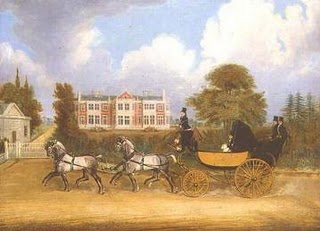
There was tax to be paid for painting your coat-of-arms on your carriage.


Some of the more unusual taxes included paying for a licence to display a coat of arms on the side of your carriage. The number of licenses rose from 14,000 in 1812 -  to 24,000 in 1831. In 1830 some 7,000 people paid to be able to print their crest on headed notepaper or have it engraved on cutlery – by 1868 this rose to over 68,000 people.
A Gillray cartoon referring to William Pitt's policy on Income Tax

Income tax was the invention of William Pitt the Younger, introduced in 1799 to cover the cost of the Napoleonic Wars. Yearly incomes below 60 GBP were exempt – a sliding scale up to 200 GBP, and then 10% levied on incomes above this. It was abolished in 1816, but reintroduced in 1842 by Sir Robert Peel, as part of his measures to reduce the duties on common goods. The tax on soap was removed in 1853…

The answer to the question posed at the beginning of this post, and it surprised me, was TEA which brought in the most at 3,832,432 British pounds  - with SILK the least earning just 214,898 pounds worth of tax. 
Gorgeous silk gowns like this, generated less tax income than soap!
The worth in tax to early 19th century Great Britain runs:
(MOST) Tea > rum > soap > coffee > silk. (LEAST)
In a way it’s heartening to see soap holding it’s own…at least that means somebody was buying it!

Sunday, 1 May 2011

How Many Wives Did Henry VIII Have?


My current guilty pleasure is watching The Tudors on DVD (a mother’s day present from my boys – clever chaps.) All of which set me thinking: How well do you know your Tudor history?
So here’s a simple question:
How Many Wives did Henry VIII have?
a)      6
b)      5
c)      4
d)      2

Now those of you with an English education will be counting on your fingers: Divorced, Beheaded, Died, Divorced, Beheaded, Survived.
So would it surprise you to learn the correct answer is d)?  TWO wives.

History has it that Henry VIII had six queens (In order)
-         Catherine of Aragon
-         Anne Boleyn
-         Jane Seymour
-         Anne of Cleves
-         Catherine Howard.
-         Catherine Parr.


A young Catherine of Aragon.
Catherine of Aragon.
Henry VIII himself annulled this marriage in his capacity of the head of the Church of England.
Annulment is very different from divorce, in that it means a marriage never took place.
Prior to Henry taking control of the church, there were two grounds for annulment – none consummation or pre-contract.
Henry argued that since Catherine had previously been married to his deceased brother, Arthur, it was “God’s Law” that the marriage did not stand, regardless of what the Pope thought, and declared they had never been married.

Natalie Dormer as 'Anne Boleyn' (apologies to the purists out there.....)

Anne Boleyn.
This time it was the Pope who declared the marriage invalid, since in the eyes of the Catholic Church, King Henry was still married to Catherine of Aragon.
Ironically, shortly before Anne’s execution, Henry annulled the marriage himself, which begs the question: - If they weren’t married, how could her supposed ‘infidelity’ amount to treason?


The famous Holbein portrait of 'Anne of Cleves.'

Anne of Cleves.
Both reasons for annulment, none consummation and pre-contract, came into play here. Henry found Anne’s physical appearance so repulsive that he wasn’t able to consummate the marriage…and… Anne was contracted to marry Francis, Duke of Lorraine, until Henry’s advisors singled her out.
In the long run Anne did rather well from her none-marriage, since Henry, glad to be easily rid of yet another ‘wife’ showered her with gifts and gave her the honoury title of ‘Beloved sister.”


Catherine Howard.

Catherine Howard.
It seems likely Catherine Howard was unfaithful before and during the marriage to Henry. When he found out, once again he used his power to declare the marriage invalid and had Catherine executed. Another none- marriage!


Jane Seymour.

And Finally.
The TWO incontrovertible marriages were to Jane Seymour (who died from puerperal fever after giving birth to Edward) and Catherine Parr (who out lived Henry, remarried, and then died in childbirth.)

Catherine Parr.

Does it bother you, that programmes such as 'The Tudors' take liberties with historical accuracy? Does it matter that the lead actor, Johnathan Rhys Meyers, doesn't have Henry's famous red hair...or is it a more important to popularise history and bring it to life?
Leave your comments below.

Wednesday, 13 April 2011

Something to Make You Smile!

A bit of fun this week courtesy of fellow Solstice author, James Hatch.
Thank you James, x.


A big thank you to James Hatch, author of 'The Substitute,' for providing the pictures.