Showing posts with label Tower of London. Show all posts

Sunday, 26 July 2015

Cats of the Tower of London: Sir Henry Wyatt and the Caterer Cat

In this our second post about cats and the Tower of London, we look at Sir Henry Wyatt and the “Caterer” cat.
Sir Henry Wyatt in later life (he was in his 20s when imprisoned)
Note the cat dragging a bird through the window

Born in 1460, Sir Henry Wyatt was a Yorkshireman and attended Eton with Henry Tudor. Unfortunately for Wyatt at the time of our story, it was not Henry Tudor on the throne but Richard III, and the later was distinctly twitchy about anyone who might support the Tudor line of accession.

Richard decided to limit any damage Wyatt might be tempted to do by imprisoning him in the Tower of London. Just to make sure he felt completely unwelcome, Wyatt was tortured, and kept in squalid conditions sleeping on straw on a stone floor and with his clothes in rags. Given very little food, he was also starving.
The Tower of London

“He [Wyatt] was imprisoned often, once in a cold and narrow Tower, where he had neither bed to oie on, nor clothes sufficient to warm him, nor meat for his mouth.”
But at this his most desperate hour an unlikely angel came to him. This angel had four-legs and a furry coat, and was actually a cat.
Earliest known surviving portrait of
Richard III

“A cat came into the dungeon with him, and, as it were, offered herself unto him. He was glad of her, laid her in his bosom to warm him, and by making much of her won her love. After that she would come at diverse time, and when she could get him one, bring him a pigeon.”


The pigeon was then duly cooked by a friendly jailor, providing much needed nourishment. Indeed, such was the cat’s provision for hm that she became nicknamed as “the caterer cat”.


In later years when Wyatt was free, and Henry Tudor on the throne, Wyatt was notorious for having a fondness for cats. Papers belonging to the Wyatt family, written in 1727, remark how:  “Sir Henry always made much of a cat, and was always to be found with a cat beside him.”

Sunday, 19 July 2015

Cats of the Tower of London: Trixie and the Earl of Southampton

Do you love cats and history? Then this post is for you.

Our history concerns the gentleman in the portrait with a fine head of hair. He is no lesser person than a Tudor aristocrat, Henry Wriothesley, the third Earl of Southampton. This dashing looking fellow was notorious for a number of reasons, not least being that he was Shakespeare’s patron and rumoured to have romantic attachments to the great bard.
But our tale concerns his political machinations, and the inspiration behind the portrait. So look closely and what do you see?


A well-dressed nobleman with bows on his cuffs. A wood-panelled chamber. A black and white cat perched on a window ledge. But look again. Did you spot behind Wriothesley’s left shoulder the painting of the Tower of London?

Wriothesley did indeed spend time imprisoned in the Tower. He chose his friends poorly, and fell in with a group of noblemen who in 1601 rebelled against the elderly Queen Elizabeth I.
Queen Elizabeth I

The aim of their insurrection was to force the Queen to name, her cousin’s son, James VI of Scotland, as her heir. They feared if she did not, there would be civil war when the Queen died. However Elizabeth believed naming a successor would number her own days – after all she had ordered the execution of James’ mother, Mary Queen of Scots.

James VI of Scotland,
in younger life

The rebels were led the Earl of Sussex, Sir Robert Devereux, and the Earl of Southampton. But their attempts to rouse London’s inhabitants one Sunday failed miserably. They had fatally underestimated the lethargy thought prosperity induced. They were captured and Essex executed.

However, Wriothesley was left to think on the folly of his actions whilst incarcerated in the Tower. His mother and wife pleaded with Elizabeth for clemency and to not execute him. For her part Elizabeth had lost her appetite for blood and agreed to let him keep his life but languish in the Tower of London at her pleasure.

Wriothesley in 1594

And this is where the cat comes in. Apparently, bereft of company and comfort, Wriothesley was pretty miserable and had an unhappy time of his imprisonment. Legend has it that Wriothesley missed his favourite cat, Trixie. In turn, she missed her master and contrived break into the prison by climbing down the chimney.
“After he [Wriothesley) had been confined there [The Tower of London] a small time, he was surprised by a visit from his favourite cat, which had found its way to the Tower.”
Thomas Pennant, 1793 “Some Account of London”.

However, a less romantic explanation exists as to how Trixie came to be there. It was muttered that Wriothesley’s wife brought the cat along on a visit.

And finally, the portrait is hugely interesting in its own right. It was painted in a rush shortly after the death of Queen Elizabeth I in March, 1603. The painting was completed in just six days and nights, and then rushed to Edinburgh for James to see. It is rich with code and appealed for the new King of England to set him free.


The code hidden within the picture includes:
·          He is wearing black, a sign of mourning for the Earl of Essex (and a hero to James).
·         A pane of glass is smashed, a reminder of the violent nature of Essex’s death.
·         His hair is shown loose around his shoulders, much like a brides – as if inviting James to become his sovereign lord.
·         The exact date of the start of his sentence is recorded on the portrait, but the date of release is left open, as if inviting James to set him free.

The new king of England was mightily impressed:

“The great and honest affection borne to us by the Earl of Southampton…we have written to the Lieutenant of the Tower to deliver him out of prison presently.”  James VI of Scotland, James I of England


Wednesday, 8 October 2014

Musings on 18th Century Portraits and Coins

 Last week I was fortunate enough to visit the "First Georgians" exhibition at the Queen's Gallery, Buckingham Palace Mews. It was an enjoyable (if slightly disjointed) display that left me faintly frustrated. However, to dwell on the positive, two portraits on display in the first chamber inspired me to write today's blog post. 

The first portrait was of Queen Anne, whose death in August 1714 paved the way for the "first Georgian", George Ludwig, Elector of Hanover, to ascend to the English throne. As much as anyone can, living in such elegant splendour, Queen Anne had a tragic life marked by 17 pregnancies, none of which provided a healthy living heir. 
The portrait of Queen Anne
I found the portrait of this somewhat matronly lady, who yet lacked a brood of children, somehow moving. And it put a new twist on the picture when I read it was painted to provide a likeness for coinage. 

Gold coins in circulation during Queen Anne's reign
Indeed, the next portrait was of her successor, King George I - and again, this picture was used to mint coins bearing his likeness. The painting was executed by Sir Godfrey Kneller and was intended to show the new king in regal glory as "Defender of Faith". 

Portrait of King George I
The results of this were on display in a separate cabinet

Is it just me, or is the coin more flattering
than the painting?
OK, there you have it, my favourite objects from the exhibition, which leads me neatly onto some Royal Mint trivia. 
From 1300 to 1812 (encompassing the period when Anne and George's coins were minted) the Royal Mint was sited within the curtain wall of the Tower of London, in Mint Street
The Tower of London with the Shard in the background.
Behind this outer wall lay Mint Street
The houses built into the outer wall that once made up the Mint, are called the Casemates. In the 18th century coal and precious metals were stored there, are well as housing the machinery for making coins. In the present day they are now home to the Yeoman Warders and and their families. 
The view on the other side of the wall.
Looking down Mint Street at the Casemates

One of the most famous Wardens of the Mint was Sir Isaac Newton (famous for his theory on gravity) who held the post for 28 years from 1696. 
Standing beside the Casemates looking inwards to the Tower
Sir Isaac's job was to investigate cases of counterfeiting and it was he moved the currency standard from silver to gold in 1717.

Tuesday, 31 December 2013

Most Viewed Blog Posts of 2013

This New Year's Eve I'd like to wish all visitors to my blog a happy and healthy 2014.
As 2013 draws to an end it seems appropriate to recap on the year gone by - and see which posts had the most views.
So - in reverse order, the 10 most viewed blog posts here on 'Fall in Love with History.'
Is there a post that sticks in your mind?
If so, it would be great if you'd leave a comment and share which posts appeal to you and why.
Grace x

PS - Click the photo for a link to the post.

#10 - Cats and the Possessed

Widget - summer 2013
#9 - Tower of London: Polar Bears in the Thames

January 2013 I visited the Tower of London

#8 - Bizarre Tudor Deaths

The memorial at the Tower of London to those executed there (including Anne Boleyn)
#7 - How Many Wives did Henry VIII have?

The wooden likeness of Henry VIII, once used to display his armour at the Tower of London's 'Line of Kings' exhibition
#6 Kensington Palace: At Home with the King

The statue of Queen Victoria outside Kensington Palace
#5 - Miraculously Improbable: The Crystal Palace

The Great Exhibition -1851, the Crystal Palace
#4 - Dog and Cat Diaries

Widget has her own way of coping with stress
#3 - Exit Napoleon Pursued by Rabbits

It turns out Napoleon was bested by rabbits...
#2 - London Bridge Legends

The Tower of London on the left and Tower Bridge (yes, I know - not London Bridge) on the right
#1 - Cats Eyes: Seeing is Believing

For the second year running, a piece about reflective road studs is the most viewed post!
Here's to 2014!
G x

Wednesday, 30 October 2013

Historical Hauntings - the Tower of London

Photo courtesy of the Historic Royal Palaces
Join the ghostly fun on twitter with #TowerGhost
There’s no better time for a ghost story than Hallowe’en and no better place to tell them, than at the Tower of London.  Over the centuries those ancient stone walls have witnessed murder, torture and imprisonment - and soaked up the distressed spirits of those who died there. Whether you believe in ghosts or not, there are compelling accounts, frequently by Yeoman Warders, of sights so terrifying that one witness even died of fright two days later. Of the ten ghostly apparitions associated with the Tower of London, here are my two favourites.
Portrait of a woman thought to be
Margaret Pole.
Margaret Pole, Countess of Salisbury
By all accounts Margaret Pole was a feisty character, but she needed to be with King Henry VIII amongst her enemies. Margaret was an unusual woman for a number of reasons: firstly, because she was a peeress in her own right (rather than being married to a nobleman) and secondly, because she reached the age of 70 – which was quite an achievement in Tudor England.
However, Henry VIII was not a fan mainly because Margaret was a Plantagenet (a rival line of accession to England’s throne)  and her son, Reginald, was a vocal critic of Henry’s religious and marital policies. Knowing Henry had charged him with treason Reginald fled abroad, but not so Margaret – who Henry arrested, put through a farcical trial and sentenced to death.
The Martin Tower at the Tower of London
Find out more at #TowerGhosts
On 27th May 1541, Margaret Pole was marched onto Tower Green at the Tower of London, where a crowd of 150 spectators had assembled to witness her execution. Margaret, however, was having none of it. She defiantly told the executioner that she refused to kneel at the block and if he wanted to cut her head off, he’d have to do it where she stood. You can almost feel sorry for the man – caught between a strident old woman and the orders of his king. In the end, the executioner took a swipe at Lady Pole, missed her neck and badly cut her shoulder. Bleeding heavily, Margaret's white hair stained red, she took to her heels and ran. Eventually, it took 11 blows to fell the countess in what was more butchery than execution.
And so the story goes that on the anniversary of her death, May 27th, her ghost re-enacts her brutal end in a macabre dance around Tower Green....
 
Anne Boleyn
Queen Anne Boleyn
Another of Henry’s victims was his second wife, Queen Anne Boleyn. Once again Tower Green provides the backdrop for a grizzly scene with a French swordsman smiting Anne’s head from her shoulders on her husband’s command. Her body was removed, placed in an empty arrow chest for a coffin and buried beneath the floor in the chapel of St Peter ad Vincula. But it seems the lady lies uneasy for in Victorian times a Captain of the Guard noticed a light burning in the locked chapel. Suspicious of what was going on he placed a ladder against the chapel window to inside. What he saw is described in this excerpt from Ghostly London, London 1882.
“Slowly down the aisle moved a stately procession of Knights and Ladies, attired in ancient costumes; and in front walked an elegant female whose face was averted from him, but whose figure greatly resembled the one he had seen in reputed portraits of Anne Boleyn. After having repeatedly paced the chapel, the entire procession together with the light disappeared.”
 
The elegant memorial to those executed on Tower Green
(author's own picture)
In 1864 a sentry of the King's Royal Rifle Corps was patrolling the grounds when he came upon an misty apparition of a woman in Tudor dress, wearing a French hood – but lacking a face! He challenged her to stop but she kept advancing so he thrust at the figure with his bayonet. Apparently, as the bayonet passed through the mist he received an electric shock. The sentry was court-marshalled for sleeping whilst on duty – but a fellow officer came forward and said that whilst he was in the Bloody Tower, he heard the man shout out a challenge and was in time to witness the shadowy figure pass through the bayonet and then the guard himself!
Those clever people at the Historic Royal Palaces have created a special hour long tour of ‘Ten Historical Hotspots’ within the Tower of London. If you are in London this Hallowe’en and want to find out more visit here:  
This blog post is part of the Trick or Treat Hallowe'en Blog Hop.
See links below for the participating blogs. 

Wednesday, 17 July 2013

Line of Kings: the Wooden Horses


Last week I was fortunate to a preview the latest 'Line of Kings' exhibition at the Tower of London [see Line of Kings: the Oldest Exhibition in the World ]. Against a clear blue sky the White Tower looked stunning, the perfect setting to set the mood for this historic attraction.


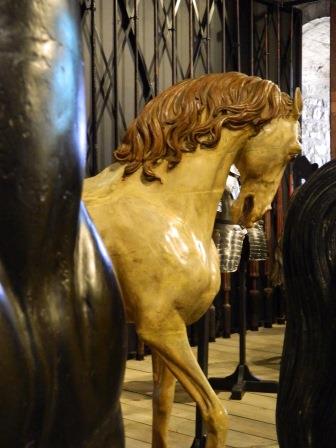
In this exhibition you will see suits of armour, including two worn by King Henry VIII, as well as life-sized horses, carved in the 1690's to display equine armour. For me it is these figures that steal the show. Because of their great age, over 300 years old, these horses are now too fragile to support the weight of armour they were originally intended to carry, but in their own right they are beautiful sculptures.


The poses of the horses are striking and a wonderfully insightful blog post on the significance of their stance can be found on here, on the 'History Needs You' blog. Be it artist or carpenter, it is obvious that whoever crafted these life-sized creatures had a wonderful empathy with the equine species. Prancing and firy, noble and elegant, you can read the respect of sculptor for subject in every vein and sinew. Indeed, the figures are so detailed that each model has horse shoes!

Detail showing the different paint finishes on the wooden horses
(Wooden horse to the left of the photo, armour to the right)
Endoscopy has given a fascinating insight into how these models were crafted. Each horse was made from wooden planking (they are hollow) and assembled with traditional carpentry techniques. If you look hard you can see the joins and wooden pins.

A detail showing the joins and a pin used to assemble the sculptures.
Over the centuries each horse has been repainted multiple times. If you look carefully you can see a small area on some of the horses (on their flank, about halfway down) made up of postage-stamp sized areas of differing colours. This is were conservationists have painstakingly removed layer upon layer of paint to reveal the previous liveries.

The horse, commissioned in 1685, used to display the model
of King Henry VIII in armour.
Unmarked and standing unassumingly amongst the rest are two horses of special significance. One is a black horse with rolling eyes and flared nostrils - this figure was the first commissioned to carry a model of King Henry VIII in his armour. The second is a prancing dun coloured horse that is a shade shorter than the others. It is suspected that this may have been carved by a man with the striking name of Grinling Gibbons.

Was this horse carved by Grinling Gibbons?
Grinling was a sculptor and woodworker whose catalogue includes carvings at St Paul's Cathedral, Hampton Court Palace and Blenheim Palace. Records exist showing the Grinling was paid forty pounds for a carving of Charles I and a horse. Later sculptors were paid half this amount.

This horse is the cuckoo in the nest - Why?
Because it was made just a couple of years ago in order to carry the weight of
Henry VIII's armour.
Some of the other wooden wonders on show at the Line of Kings include wooden carvings (from the late 17th century) in the form of the likenesses of monarchs, including Henry VIII and Charles I.

Carved in wood - the likeness of King Henry VIII-
part of an exhibition created 300 years ago

I would like to thank the lovely people at the Historic Royal Palaces, and John Shevlin in particular, for inviting an ordinary blogger to a preview of this wonderful exhibition. For those wishing to visit the Line of Kings, entry is free, included as part of the admission fee to the Tower of London.

Tuesday, 16 July 2013

Line of Kings: The Oldest Exhibition in the World


Q: How long has the world’s oldest visitor attraction been on show?

The Line of Kings
A: An amazing 350 years – and the attraction is the Tower of London’s evocative Line of Kings’ exhibition. But just in case you are thinking the exhibits might be a bit dusty by now – let me assure you that the latest incarnation of this wonderful display is anything but dull!

In the 17th century the aim of the attraction was to display the king’s armour and weapons, and remind subjects of the power of the crown. This latest take on historical armaments has added interest for today's visitor with a display of magnificent, life-sized wooden horses. These horses, carved in the 1690's, were designed as mounts suitable to showcase a king's armour, and in the modern day make breath-taking sculptures in their own right.
The White Tower -
at the Tower of London
Set in the historic White Tower, the very first ‘Line of Kings’ display coincided with the restoration of the monarchy in 1660.  The exhibition of royal armour was open to the public and was more concerned with pomp than historical accuracy. For instance, William the Conqueror’s armour was exhibited - despite it being in a style not designed until several hundred years later.

Carved wooden likeness of Henry VIII-
created the late 1690's
Somewhat ironically, when William’s armour was removed from display in 1826 (because of historical inaccuracy), the suit was then reassigned to another nobleman! That said, it seems early visitors were not unaware of the liberties being taken with history if the account below is anything to go by:
 “As we gently mov’d along and viewed the princely scarecrows, he [the guide] told us to whom each suit of armour belong originally, adding some memorandums out of history…some true some false, supplying that with invention which he wanted in memory.”
Ned Ward- visiting the Tower of London in 1699

King Henry VIII armour on display
The current Line of Kings’ exhibition is now open at the Tower of London.  Armour worn by Henry VIII and Charles I (amongst other royals) is on display, but the highlight of my visit and personal favourites are the gorgeously carved wooden artefacts in the form of life-sized prancing horses. [More about the horses in my next post]
Detail from Henry VIII's armour
As well as those fabulous horses there is an eerie cabinet displaying the carved likenesses of kings’ heads and hands. To whet your appetite further, below is a photo of the wooden horse made to display King Henry VIII’s armour in a late 17th century display.
The original horse created to display
King Henry VIII in his armour

 Entry to the Line of Kings exhibition is included as part of the entrance fee to the Tower of London.
#LineofKings