Showing posts with label Henry III. Show all posts

Wednesday, 20 February 2013

Tower of London: Polar Bears in the Thames


In this the third post about animals at the Tower of London, we look at bears - or polar bears to be precise.
One of the sculptures (made from chicken wire) at the Tower of London
In 1252 King Henry III (1207 - 72) was given a Norwegian bear by King Hakon V. This bear was described as "pale" , which is significant because the black bear (albeit sometimes light coloured) was common in England at the time. It seems likely that this bear was significantly different in order to merit it being a gift, and was probably a polar bear.

The bear arrived with a keeper, and once again the Sheriffs of the City of London were asked [told] to pay for the animals upkeep. The Sheriffs allotted around tuppence a day, which considering the prevalent poverty of the day, must have seemed galling to some. However, after a year, the sheriffs decided it was time the bear caught it's own food in the Thames; at that time the Thames was a clean river, rich with salmon and fish.
"fat and sweet salmon [are] dailie taken."
 
The White Tower at the Tower of London
The bear was fitted with a chain and muzzle, and the keeper expected to take the beast down to the river to fish and bathe. The sheriffs thoughtfully provided the keeper with a thick cape, presumably to keep out the cold on the riverbank.

"Greetings. We [the King] command you that for the keeper of our white bear , recently arrived from Norway… ye cause to be had one muzzle and one iron chain to hold the bear without the water, one long strong cord, to hold the same bear fishing or washing himself in the Thames."

The Tower of London with Tower Bridge (over the Thames)
in the background.
King Edward I (Henry III's son) took an interest in his father's menagerie. He employed 4 keepers, each paid 3d each a day, plus a 10d allowance towards animal food. Some thirty years after the original bear, records exist of payment for a white bear called Lynn (she originated from a place of the same name) being transported by boat (presumably up the Thames) to the Tower.

A few centuries later, it seems curiosity was superseded by cruelty. King James I of England (1603-25) made the bears, lions and dogs fight each other. To this end he had a platform built from which he could watch the so-called 'sport'. This was a vicious activity where the bears were often chained and toothless, and had massive mastiff dogs set on them. The 'sport' was in betting on which animal would inflict the most damage.

 
And finally, did you know that most polar bears are Capricorns - since the majority are born between late December and mid January.

Wednesday, 13 February 2013

The Tower of London: of Elephants and Wine


“We believe that this was the only elephant ever seen in England.”
Matthew Paris
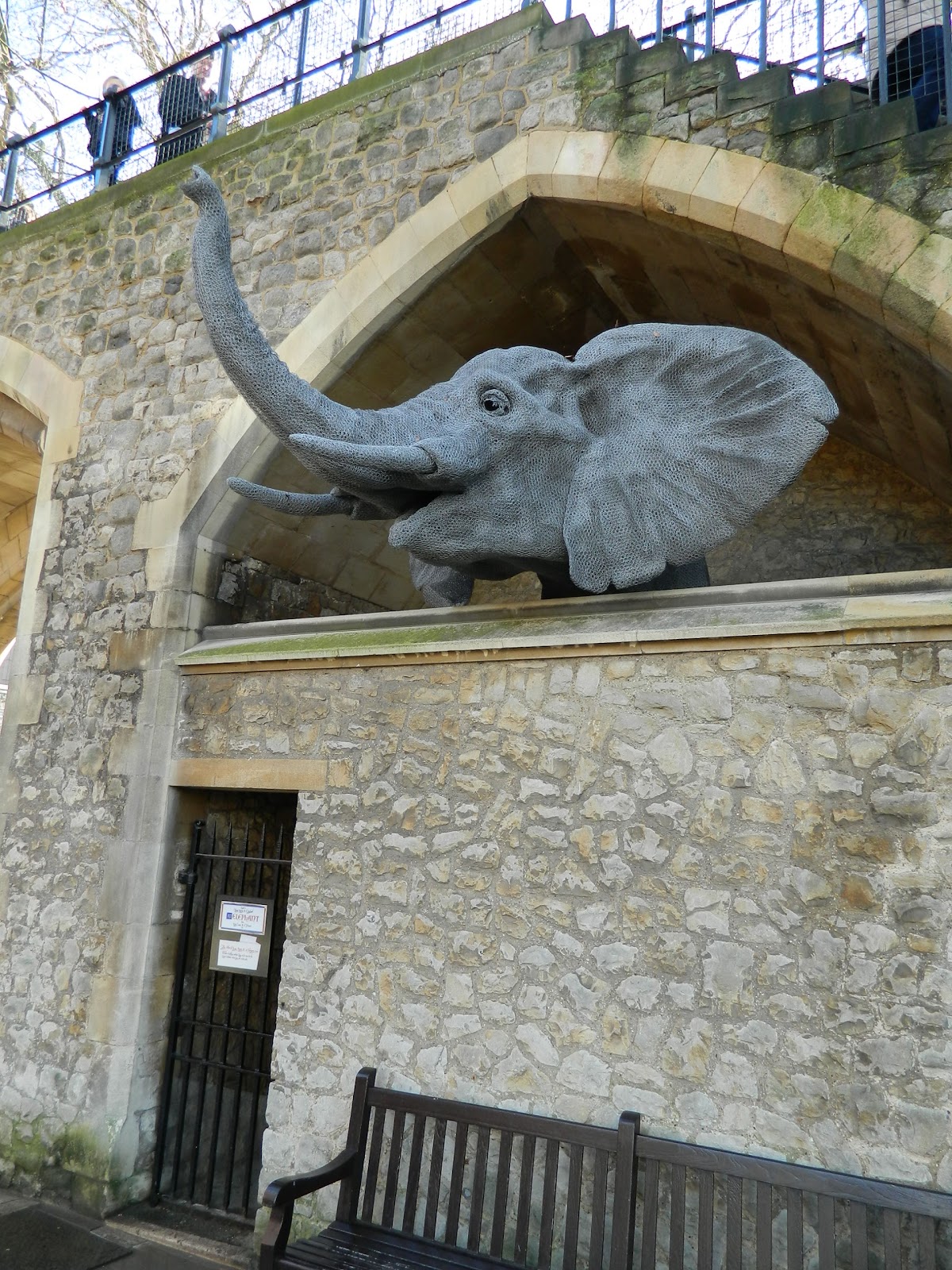
Look closely - can you see the sculpture is made from chicken wire?
This blog post was inspired by the wonderful elephant sculpture on display at the Tower of London. I wanted to find out about elephant keeping at the Tower, which it transpires was well-intentioned but misinformed. Read on…

A Jumbo-sized Gift

The first elephant at the Tower was a gift from King Louis IX to King Henry III. The animal was a trophy from the crusades in Palestine, but it's quite possible the present was a major headache for Henry. A mandate records, 7 January 1239, orders for the Sheriff of Kent to arrange transport (presumably at his own expense) for the beast.

"…to provide bringing the King's elephant from Whistsand to Dover, and if possible to London by water."
Henry III's tomb

Housing the Beast

Henry's menagerie at the Tower was started in 1235 with the gift of three leopards as a wedding present from Frederick III, the Holy Roman Emperor. One can only imagine what an awe-inspiring sight his collection must have been, but it seems Henry didn't expect to shoulder the cost himself, but deferred this to the Sheriff of London.

“We command you,” Henry wrote to the Sheriff of London, “that ye cause without delay, to be built at our Tower of London, one house of forty feet long and twenty feet deep, for our elephant.”

Interestingly, the wooden elephant house at 20 by 40 foot was roughly the same dimensions as the recently decommissioned elephant house at London Zoo - only the later housed three, rather than one, elephant!
Whilst the kudos of the animals was appreciated by royalty, the expense was not. When James I was gifted an elephant in 1623, from Spain, someone pithily records:

'the Lord Treasurer will be little in love with presents which cost the King as much to maintain as a garrison'

Ancient and modern: The Tower with the Shard in the background
Author's own photograph.
A Great Draw

In the 13th century few people had ever seen an elephant. Drawings of them were created from descriptions, rather than life, and so ended up looking like horses with long noses. When the elephant arrived at the Tower, such was the draw, that the monk and historian, Matthew Paris, travelled specifically from the abbey at St Albans to study and drawn the animal.

Matthew's drawing is one of the first naturalistic pictures of an elephant. He depicted it with the keeper, Henricus de Flor, in order to show the scale, and described it has having:
"Small eyes on top of his head, and eats and drinks with a trunk."

One of the first naturalistic pictures of an elephant -
By Matthew Paris of Henry III's elephant and his keeper.
 Keeping Out the Cold

Sadly, for many centuries no one bothered to find out what care the elephants needed to stay healthy. This was typified by James I's elephant, which came with instructions to give it only wine to drink in the winter months, to 'keep out the cold'. The poor animal drank over a gallon of red wine a day, without anyone stopping to query how an elephant would acquire wine in the wild. This elephant didn't live long, but worse still, no lessons were learnt and for another couple of centuries the myth remained and Tower elephants were given wine to drink.

And finally

When Henry III's original elephant died, its grave was near the chapel on Tower Green, close to where Anne Boleyn was later to be buried. However, the bones were later dug up and it is said that 13th century bone and ivory caskets that house reliquaries, (kept at the Victoria and Albert museum) are made from the remains of that elephant.