Showing posts with label smuggling. Show all posts

Wednesday, 18 July 2012

Horse Play - Smuggling #5


Have you ever seen a horse acting suspiciously?

Well that’s exactly what 18th century revenue officers were on the look out for!
Smugglers, once their contraband was ashore had to transport it inland for sale, and for this they needed horse power. Some gangs used equines employed in legitimate trade as cover for owning large numbers of horses. An example were the horses of the North Kent Seasalter company: by day they shifted timber from the Forest of Blean to the local tanneries, and by night transported contraband inland. A smuggling gang on Romney Marsh also owned horses, but set them to graze in groups of two or three to attract less attention, but when rounded up could raise a caravan up to 200 beasts strong.


The free-traders were notoriously cunning and this extended to their horses. Stories exist of smugglers shaving their horses and soaping or oiling them, to make it more difficult for the excise men to capture them. These horses were highly trained and their cunning masters also taught them to stop on the command "Gee-up" and bolt when told "Woah!"


Many of these horses could also find their own way home. This came in handy with the nag loaded with contraband, leaving the smuggler free to create a diversion for any prying eyes. The horse, carrying illicit barrels, found his way back to the stable where a conspirator waited to unload. A variation on this story was one horse who became disoriented by the alcoholic vapours eminating from the tubs strapped to his back, and wandered to his neighbour's house - who happened to be a customs officer. The officer, alerted by the sound of hooves, impounded the contraband and then followed the now unladen horse as he found his way back to the correct house.


Another way of obtaining horsepower was to have an agreement with local farmers. In Great Holland, one particular farmer was fond of drinking spirits and left his gate unlocked when his barrel was running low, as a sign that his horses could be used in return for a tub of gin or brandy.
"I know he's around here somewhere...."
However this cosy arrangement did not always run smoothly. A winded or exhausted horse was no use for farm work, but to refuse smugglers the priviledge of 'borrowing' a horse could result in a campaign of intimidation. Akin to a modern protection racquet, those who didn’t co-operate found hayricks catching fire, sheep falling ill, or on one occaision a farmer returning from market was unseated from his horse by a cord stretched between two trees across the road.


In my latest release,  our heroine, Hope Tyler falls foul of a smuggler bent on revenge...find out how and why by reading 'Hope's Betrayal'.

Wednesday, 11 July 2012

A Place of Safety - Smuggling #4

'A dreadful thing from the cliff did spring.' - Old Norfolk folk tale
From ghostly dogs to hidden chambers under dung heaps - smugglers were very resourceful at hiding contraband and truth being stranger than fiction, in the 18th century methods of concealment were many and varied indeed.
Hiding contraband liquor in a pub cellar was an obvious a solution except that the smaller kegs used by smugglers were easy to spot. However, the landlord of the 16th century 'Spread Eagle' pub was one step ahead; his tavern possessed a concealed well, accessible only from the roof, the shaft of which provided an excellent hiding place. Failing that, there are many tales of landlord's wives in their voluminous skirts, sitting on top of barrels to hide them whilst the revenue man made his rounds.
A less obvious hiding place was the church. Situated on Romney Marsh, Snargate Church had a crypt that was used for storing tobacco. Indeed, on one occasion in a thick fog, the vicar was able to safely find his way to the church by following the strong smell of tobacco! Apparently the nave of Snargate Church is decorated with a painting of a ship, which is an early smugglers symbol, code for a place of safety.


Another church hiding place was the ceiling void, although this wasn’t always without consequence. During Sunday service at Langton Matravers, the choir was singing a psalm when the roof collapsed and kegs rained down on the congregation.
Some tricks were inventive, such as having a fire-proof void beneath a hearth. When the revenue men called a fire was lit on top of the hidden chamber to prevent detection. A similar idea was using a cellar hidden beneath a dung heap. The dung was moved aside to reveal a trap door, the contraband concealed, the manure replaced and a herd of sheep driven past to cover the footprints. However in the case, tragedy resulted. When the gang went to retrieve their goods, they failed to listen to warnings about letting the foul air in the cellar clear before going in. Three men were overcome by fumes, two of whom died as a result.

Moonrakers.
 Another place was a false partition in a stable - with the addition a vicious horse guaranteed to kick any intruders. In some villages smuggled goods were weighted down and thrown into the village pond, to be retrieved at a more convenient time. When revenue men came across villagers in Bishops Canning, Wiltshire, trawling the pond with line and hook, they demanded to know what was going on. The villager pointed to the moon's reflection and said he was trying to recover, "The big yellow cheese". This trick earned them the nickname of "Moonrakers." In true British humour the inhabitants of Bishops Canning reveled in their new notoriety and even spread rumours that they put manure around the church tower to make it grow taller.


And finally, another way to discourage unwanted snooping was to spread fear. A Cornish vicar was said to be able to 'raise dead and lay ghosts' at will; a tall tale to keep people away from the graveyard when a smuggling run was in progress. A similar story was spread that local cannibals hid tubs of human flesh in nearby caves, and they would eat anyone found disturbing the kegs. There is also a persistent Norfolk legend about Old Shuck, a ghost dog with a one glowing eye and fiery breath. Anyone seeing Old Shuck was sure to be dead within the year. To further terrify gullible villagers the smugglers tied a lantern round the neck of a black ram when a landing was due, to scare away nosy locals!
With all of this to contend with, you have to feel sorry for Captain Huntley in his fight against smugglers! Find out how he gets on in "Hope's Betrayal." (Currently a 25% discount on the cover price during July at Smashwords - just enter the code SSW25. http://www.smashwords.com/books/view/163804 )


Wednesday, 27 June 2012

Did You Know...? - Smuggling #3

Not that sort of barrell!
What links the following items: Prunes, salt, string, soap, paper, black pepper and brandy?

The answer is they were all once smuggled goods. In the 18th century it wasn’t just luxury items that were smuggled, but anything in demand that would raise a profit. Indeed, one chapel in Pembrokeshire was lit by candles made of smuggled tallow:
"One evening, the chapel being lighted with those candles, by some means… the excise officer became aware…and suddenly appeared and commandeered all the candles, leaving the congregation in the dark."
A smuggler's barrell with hidden compartments.
In order to maximise the quantity of smuggled goods per run, alcohol and spirits were transported undiluted, straight from the still. This was dangerously strong, and virtually colourless. Dilution to make it drinkable was a relatively simple matter, but no one wanted to buy clear brandy, and so caramel was added to achieve the traditional colour.
Undiluted spirits were drinkable but potentially lethal. When a smuggler's ship ran aground in shallows near Harwich, they threw their cargo of barrels overboard to lighten the vessel. Soldiers from a nearby fort seized the alcohol and took the opportunity to celebrate - the next day four of them died from alcohol poisoning.

Tubs and barrells were sometimes hidden beneath the boat.
Because the alcohol was so concentrated, it could be transported in smaller barrels, or tubs, making it easier for men to carry ashore. The writer Thomas Hardy recalls these tubs in his notebooks.
"…my grandfather used to do a little smuggling, his house being a lonely one. He sometimes had as many as eighty tubs in a dark closet…the spirits often smelt all over the house, being proof, and had to be lowered for drinking."
He goes onto describe a tub and how it became an everyday object.
"The tubs …were of thin staves with wooden hoops. I remember one being turned into a bucket by knocking out one head and putting in a handle."
Thomas Hardy.
Modern Calais.
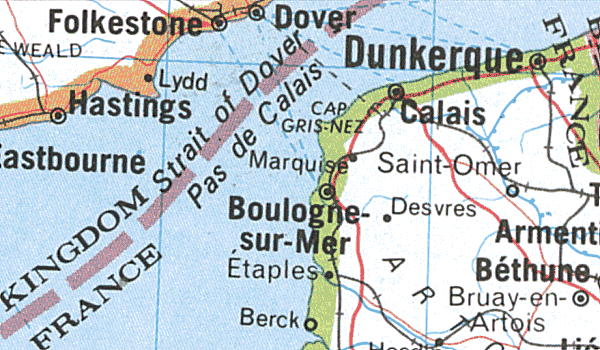
It's also interesting to note that many modern French ports owe their development to smuggling. Ports such as Boulogne, Calais, Dieppe and Le Havre were conveniently placed for short crossing from England and had good harbours. They may have started as sleepy fishing ports but as they realised the potential for free-trade and easy money, they transformed themselves into centres of commerce.

"Roscoff…and unknown and unfrequented port…grew in importance so that from small hovels it soon possessed commodius houses and large stores…These….gave every incentive to the British smugglers to resort there and …the French government afforded encouragement to the merchants."
French report, 1767

Whilst smuggling may have started small scale, when for instance a draper wished to stock his shop more cheaply, but in the mid 18th century a change took place. Wealthy city backers started financing runs as a form of investment. These men fronted the cash to buy foreign supplies and pocketed the profits, but avoided the physical lifting-and-shifting of smuggling. They were a bit like modern speculators on the futures market, city financiers who weren’t worried about the ethics of their trade.
These wealthy men risked a lot of money and in 'Hope's Betrayal', our villain is just such a man, and when he perceives Hope has betrayed him to Captain Huntley, becomes obsessed with revenge and resolves to destroy what the Captain holds most dear.

Photo courtesy of Inkity.com

Wednesday, 20 June 2012

Would You Break the Law? - Smuggling #2

            I love this comment on the character of smugglers:
            "…a person who…would have been in every respect, an excellent citizen had not the laws of his country made that a crime which nature never meant to be so."
            Adam Smith. An Inquiry into the Nature and Causes of the Wealth of Nations 1776.

Smuggling - the art of concealment?
            In the 13th century custom houses were concerned with collecting export duties on the wool that made England wealthy. It was the 18th century that saw heavy taxation placed on the import of goods - leaving meagre number of officers to enforce collection - hopelessly outnumbered by spirited Englishmen determined to defraud the crown of revenue.
            In the 18th century smugglers saw themselves not so much as law breakers but 'free traders.' Indeed, such was the sympathy for cheating the crown of tax that whole communities mobilised themselves to unload illegal landings of tobacco, brandy and tea
.

            So who were these smugglers?
            This quote about Niton, Isle of Wight, sheds some light on the answer.
            "The whole population are smugglers. Everyone has an ostensible occupation, but nobody gets money from it….here are fishermen who never fish…and farmers who farming consists of …standing like herons on look out posts."
            Sidney Dobell, 1860

            Daniel Defoe (author of Robinson Crusoe) wrote of Lymingtion in 1724;
            "I do not find they have any commerce, except smuggling and roguing, which… is the reigning commerce of all this part of the English coast."

Celebrated author, Daniel Defoe.
It seems everyone was either involved with the illegal importing of foreign goods, or the purchasing of them, as John Wesley recounts of St. Ives.
            "well-nigh one and all bought and sold uncustomed goods."

John Wesley had plenty of opportunity for observing those around him.
Those involved in the illegal trade were not just shady characters or poor fishermen, but stretched to doctors, clerics and even rich aristocrats in search of excitement. The Rev. Forbes Phillips in his book "The Romance of Smuggling" tells a story of one of his predecessors at the vicarage. Apparently one visitor to the parish spotted illegal activity on the shore and cried out,
            "Smuggling! Oh, the shame of it! Is there no magistrate to hand, no justice of the peace? Is there no clergyman, no minister?"
            The naïve visitor's protests were silenced when the locals pointed out it was the vicar holding the lantern.
Smugglers on-shore, awaiting the arrival of their load.
Of course the incentive for taking part in, or turning a blind eye to, smuggling was financial. At a time when everything from salt to silk, and tea to tobacco was taxed, cutting out the governments share meant people might be able to afford a little comfort in their lives. Such was the way of the world back then, that a little casual handling of illegal goods was looked on as common place, as in this diary entry by Parson Woodforde.
            "Andrews the smuggler brought me this night about 11 o'clock a bag of Hyson Tea, 6 lb weight. He frightened us a little by whistling under the parlour window just as we were going to bed. I gave him some Geneva (gin) and paid for the tea at 10/6 a lb."
Smuggled goods being transported ashore.

In Hope's Betrayal, our heroine Hope Tyler, turns to smuggling as a means of supporting her ailing father. So the question is, would you break the law if all around you were doing the same, and is it acceptable to defraud the government? Do share you thoughts and leave a comment.

How do you smuggle a cat into a football stadium?
             

Wednesday, 13 June 2012

A Local Legend - Smuggling

'The Smugglers' cottage, IOW, getting ready for the Diamond Jubilee!
18th century smuggling - a world of danger, daring, hi-jinks and romance!
This June, with the release of "Hope's Betrayal", welcome to a series of blog posts about the world of smuggling, including: press-ganged doctors, church hideouts, ghosts, tunnels, fake funerals, myths, pitfalls and more!
Low tide in St Helens harbour- the shallow waters made it ideal for smugglers to navigate.
The starting point on this journey is the Isle of Wight which is also the inspiration behind "Hope's Betrayal." I fell in love with the Island about ten years ago. In a strange quirk of fate for seven years I lived in Portsmouth, a twenty minute ferry ride away but without visiting. It took motherhood and two dinosaur mad sons both desperate to visit the newly opened "Dinosaur Isle" museum on the IOW (Isle of Wight) for us to go. 
Dinosaur Isle Museum (shaped like a Pterosaur) Sandown, IOW.
We stayed in a caravan park overlooking St Helens harbour and on a walk round the village I spotted a blue plaque on a fisherman's cottage. (In the UK places of special historical interest are marked with a 'blue plaque' giving brief details of who lived there.) Intrigued by the inscription about "The Lady of Chantilly" I visited the Newport Museum to do some research. The result was a fascinating true story of a humble fisherman's daughter, born around 1792, who was a part-time smuggler. This girl was so beautiful, that when caught her red-handed, the revenue officer couldn’t bring himself to arrest her. What a fabulous idea for a historical romance and out of this local legend, the idea behind "Hope's Betrayal" was born.
The blue plaque that inspired a novel!
My story is a fictional account of two people on opposite sides of the law, falling desperately in love. How can such love survive if it means compromising everything they believe in? In a choice between betraying your family, or losing a career, what you chose?
I was on the Island during the recent Diamond Jubilee celebrations for Queen Elizabeth II and hope you enjoy the photos of some of the local cottages, decked out with bunting.
The local pub (overlooking the Village green) decked out with bunting.
Next week: Smuggling - Women Smugglers.

'Hope's Betrayal' - the story:
One wild, winter's night two worlds collide.
Known for his ruthless efficiency, Captain George Huntley is sent to stamp out smuggling on the south coast of England. On a night raid, the Captain captures a smuggler, but finds his troubles are just beginning when the lad turns out to be a lass, Hope Tyler.
With Hope as bait, the Captain sets a trap to catch the rest of the gang. But in a battle of wills, with his reputation at stake, George Huntley starts to respect feisty, independent Hope. Challenged by her sea-green eyes and stubborn loyalty Huntley now faces a new threat - his growing attraction to a sworn enemy. But a love where either Hope betrays her own kind, or Captain Huntley is court-marshaled, is not an easy destiny to follow.
Widget relaxing whilst on holiday on the IOW.

Wednesday, 28 September 2011

When the Past Becomes History.

‘Smuggling, though a real offence, is owing to the laws themselves, for the higher the duties, the greater the advantage and consequently the temptation.’
1768 Treatise on Crimes and Punishment, Beccaria.
I’m currently researching my WIP (work in progress) about smuggling along the south coast of England in the 18th century, and so imagine my surprise when my husband produced a small beige-coloured book on the subject from our very own bookshelves! The interesting thing is, the more I read, the more I realised this book itself, was a piece of history!
‘The Smugglers of Christchurch, Bourne Heath and the New Forest’, by E Russell Oakley, published in 1924, turned out to be a wonderful glimpse into the history – not just of smuggling, but also of the 1920’s.
Excisemen tackle some smugglers in their lair.
In the book Mr Oakley writes about a talk on smuggling he gave on BBC radio, in January 1924. He recounts the true story of a fast sailing boat with a cargo of contraband tea which, in 1748, was chased by Revenue cutters. In danger of being overhauled and captured, the smugglers jumped overboard in shallow water just off Bourne Heath and swam ashore to escape. In his radio broadcast Mr Oakley bemoans:
“It is curious that contemporary records give us so much detail, yet the name of the boat and her home port are not stated.”
Smugglers ashore, signalling they are ready to recieve the landed contraband.
And it’s this next bit that I love as a reflection of history-within-history. In his book, Mr Oakley recounts that a week after the program he received a letter which read:
“Last week I purchased a wireless set. [Don’t you just love it? Owning a radio was so unusual the writer mentioned it in his letter!] Last Saturday night I listened in for the first time and you were the first speaker I have heard on the air.”
The letter goes onto say:
“I am going to tell you something you don’t know. That boat belonged to a relative of our family and the loss of it broke his heart and he died soon afterwards. The name of the boat was ‘Charles’ and she was…an oyster dredger and fishing boat.”
How wonderful, that the new-technology of the ‘wireless set’ provided an answer to a question nearly two centuries old!
Smugglers at work.
Another fascinating glimpse into the past is the mention of what were then hamlets and villages, - Shirley – a hamlet four miles away (now a waste concrete and brick, sprawling suburb of Southampton, and anything less idyllic or hamlet-like it’s difficult to imagine.) And of course there is the Bourne Heath of the books title – which it transpires is the forerunner of the well-known seaside resort and popular retirement town of Bournemouth. In Victorian and Edwardian times the transformation from sleepy Bourne Heath, to bustling Bournemouth was underway, as E Russell Oakley writes in 1924:

“Many places in the coastal belt….have entirely disappeared, submerged under a titanic tide of bricks, cement, reinforced concrete and Trinidad asphalt.”
Bournemouth (seen from the air) as it appears today.
‘I spent my nineteenth summer on a smuggling coast…The contraband trade was at that time very successful, and it happened to me to fall in with those who carried it on.’
Robert Burns 1778.